
Deradicalizing Syria's Children of ISIS
A guest post by Emma Scherer, Middlebury Institute for International Studies (MIIS'25) who excelled in our Counterrorism Class this Fall 2025.

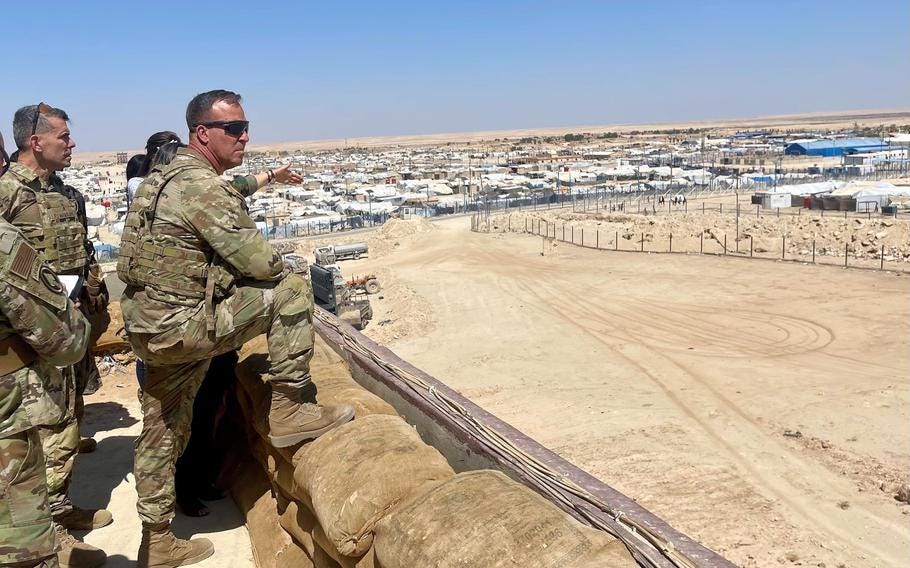
caption: U.S. Central Command leader Gen. Michael “Erik” Kurilla visits the al-Hol camp in Syria on Sept. 9, 2022. Kurilla recently called the camp, which holds many of the wives and children of captured Islamic State fighters, a “flashpoint of human suffering.” (U.S. Central Command) https://www.stripes.com/theaters/middle_east/2023-04-10/isis-prison-syria-military-centcom-9758748.html (Stars and Stripes)
By Emma Scherer
Asaad Alsaleh’s “Deradicalizing Syria’s Children of ISIS: A humanitarian imperative” (2019) argues that programs focused on the deradicalization of Syrian children living under ISIS must be put into place not only “because of the threat of terrorism these children could eventually pose,” but more importantly for humanitarian reasons. While noble in its goal of shedding light on an underdiscussed issue, Alsaleh’s report focuses too heavily on the humanitarian aspect, which is doubtful on its own to prove convincing to potential state donors. Additionally, the report omits discussion of the potential challenging factor that ISIS-affiliated families will play in children’s reintegration. Finally, the report’s focus on education and deradicalization of youth ISIS members is lofty and ignores the more practical short-term goal of disengagement.
“Deradicalizing Syria’s Children of ISIS” fills a gap in the literature on the deradicalization of ISIS youth. More specifically, it draws attention to the fact that Syrian children have “been neglected” in the wider discussion of youth reintegration (Alsaleh 2019, 2). This claim is supported by Cook (2023), who argues that “a significant portion of the literature [on ISIS affiliated youth] has focused on western case studies”(43). Addressing this gap is crucial, given that deradicalization programs designed for children returning to rich Western countries are unlikely to be effective or feasible in regions still undergoing significant turmoil.
Although noble, Alsaleh’s framing of the deradicalization of ISIS youth as primarily a humanitarian issue may not prove sufficient in impelling countries to act. Although states do often engage in international humanitarian efforts, they often are motivated by some national interest (see: Cabestan), rather than engaging simply “for the sake of the children”(Alsaleh 2019, 18). As such, the claim that “the stakeholders in the conflict [in Syria] need to take responsibility for disengaging children” as “an international humanitarian priority”(13) is unlikely to see results without presenting potential incentives for international actors. Instead, Alsaleh and others attempting to impel international action should highlight the potential security threat posed by these children if left radicalized, as does Pasagic (2019), Cook (2023), Almohammad (2018, 23), and Cragin (2018).
Additionally, Alsaleh’s proposed program of deradicalization is lacking in a few key areas. Firstly, there is no discussion of the role of family ties, which could potentially problematize deradicalization efforts. As noted by Almohammad (2018), children of ISIS operatives face unique challenges in reintegration, as their indoctrination is “more intense”(23). Indeed, so-called “kinship radicalization” is imbued with additional emotional intensity, making it harder for individual family members to break ties with the extremist group (Hafez 2016, 16). As such, any deradicalization program must consider the factor of family ties.
Furthermore, the focus is placed too heavily on education programs, which may not have much effect. Alsaleh goes as far as claiming that “only if the efforts allocated to war are redirected to education will they [radicalized children] be free from such prisons [terrorist ideology]”(2019, 16). While investing in education is certainly a noble cause for a variety of reasons, preventing children from taking part in violent extremist groups may not be one of them. Indeed, according to J.M Berger, the link between low levels of education and participation in terrorist groups is “unclear and often contradicted,” with some studies even finding that participants in VEOs have higher average levels of education (2016, 5-6). As such, deradicalization programs focused solely on education levels are doomed to fail.
Finally, too much of the emphasis is placed on the lofty, long-term goal of ideological deradicalization. Instead, programs should focus on the more practical, short-term goal of disengaging ISIS youth. Alsaleh tends to conflate these two goals, defining radicalization as both ideological (“the process in which individuals with extremist political, religious, or social views try to instill such views in others”(8)) and action-based (“individuals stand ready to act upon the extremists’ directives, including the use of violence or terrorism”(8)). As noted by Khalil et al. (2022), this combined model is limiting, as participants in VEOs can change their behavior (i.e. “disengage”) without necessarily ending their beliefs in radical ideologies (438). Given the scant resources in the Syrian case (see: Alsaleh, 17), it seems much more prudent to prioritize the relatively smaller goal of disengagement rather than beginning with deradicalization.
Works Cited:
Almohammad, Asaad. “ISIS Child Soldiers in Syria: The Structural and Predatory Recruitment, Enlistment, Pre-Training Indoctrination, Training, and Deployment.” ICCT, February 2018.
Alsaleh, Asaad. “Deradicalizing Syria’s Children of ISIS: A Humanitarian Imperative.” Center for Global Policy, August 2019.
Berger, J.M. “Making CVE Work: A Focused Approach Based on Process Disruption.” ICCT, May 2016.
Bloom, Mia, John Horgan, and Charlie Winter. “Depictions of Children and Youth in the Islamic State’s Martyrdom Propaganda, 2015-2016.” CTC Sentinel, February 2016, 29–32.
Cabestan, Jean-Pierre. “China’s Evolving Role as a UN Peacekeeper in Mali.” US Institute of Peace, 2018.
Clifford, Bennett, and Seamus Hughes. “The History of Countering Violent Extremism Tends to Repeat. It Shouldn’t.” Lawfare, July 17, 2022. https://www.lawfaremedia.org/article/history-countering-violent-extremism-tends-repeat-it-shouldnt.
Cook, Joana. “Distinguishing Children from ISIS-Affiliated Families in Iraq and Their Unique Barriers for Rehabilitation and Reintegration.” Perspectives on Terrorism 17, no. 3 (September 2023): 42–69. https://doi.org/10.19165/jnca8036.
Cragin, R. Kim. “Preventing the next Wave of Foreign Terrorist Fighters: Lessons Learned from the Experiences of Algeria and Tunisia.” Studies in Conflict & Terrorism 44, no. 7 (February 7, 2019): 543–64. https://doi.org/10.1080/1057610x.2019.1568005.
Hafez, Mohammed M. “The Ties That Bind: How Terrorists Exploit Family Bonds.” CTC Sentinel, February 2016, 15–17.
Horgan, John G., Max Taylor, Mia Bloom, and Charlie Winter. “From Cubs to Lions: A Six Stage Model of Child Socialization into the Islamic State.” Studies in Conflict & Terrorism 40, no. 7 (August 5, 2016): 645–64. https://doi.org/10.1080/1057610x.2016.1221252.
Khalil, James, John Horgan, and Martine Zeuthen. “The Attitudes-Behaviors Corrective (ABC) Model of Violent Extremism.” Terrorism and Political Violence 34, no. 3 (December 18, 2019): 425–50. https://doi.org/10.1080/09546553.2019.1699793.
Pasagic, Aleksandar. “Between Child Soldiers and Terrorists: Reintegrating Child Members of the Islamic State.” Journal for Deradicalization 20 (2019): 109–55.
Schmid, Alex. “Radicalisation, De-Radicalisation, Counter-Radicalisation: A Conceptual Discussion and Literature Review.” ICCT, March 2013.
Emma Scherer is a Master's student in Nonproliferation and Terrorism Studies (NPTS) at the Middlebury Institute of International Studies (MIIS), expected to graduate in 2025 (MANPTS '25), who has gained valuable experience through an internship at Lawrence Livermore National Laboratory (LLNL), focusing on nuclear safeguards and building connections in the field.
Really sharp critique here. The distinction between disengagement and deradicalization is crucial but often gets muddled in policy circles. When I was workng with community programs in a different context, we saw time and again that behavioral change happens way faster than ideological shift. The bit about kinship radicalization adds important nuance too since family bonds create an entire social scaffolding that pure education programs cant really address. Alsaleh's heart is in the right place but pragmatic resource allocation in Syria demands we prioritze keeping kids out of militant activity first.